
Mardin & Tur Abdin
published in CORNUCOPIA, issue No 68, 2025
The view south from Mardin is so bewitching, so conducive to idle observation, so vast in the sweep of landscape, so rich in the elemental forces of history, that the alleys of the city have to turn their back on it, in order to get on with the business of life. Three narrow veins of commerce, linked by courtyards and staircases and lined with stalls, animated workshops and cafés thread their shady passage through its mellow, golden-stone. After a week, I had just enough time to create a map of walked experience, though there were ravishing buildings that I had once stumbled upon by chance, but could never find again.
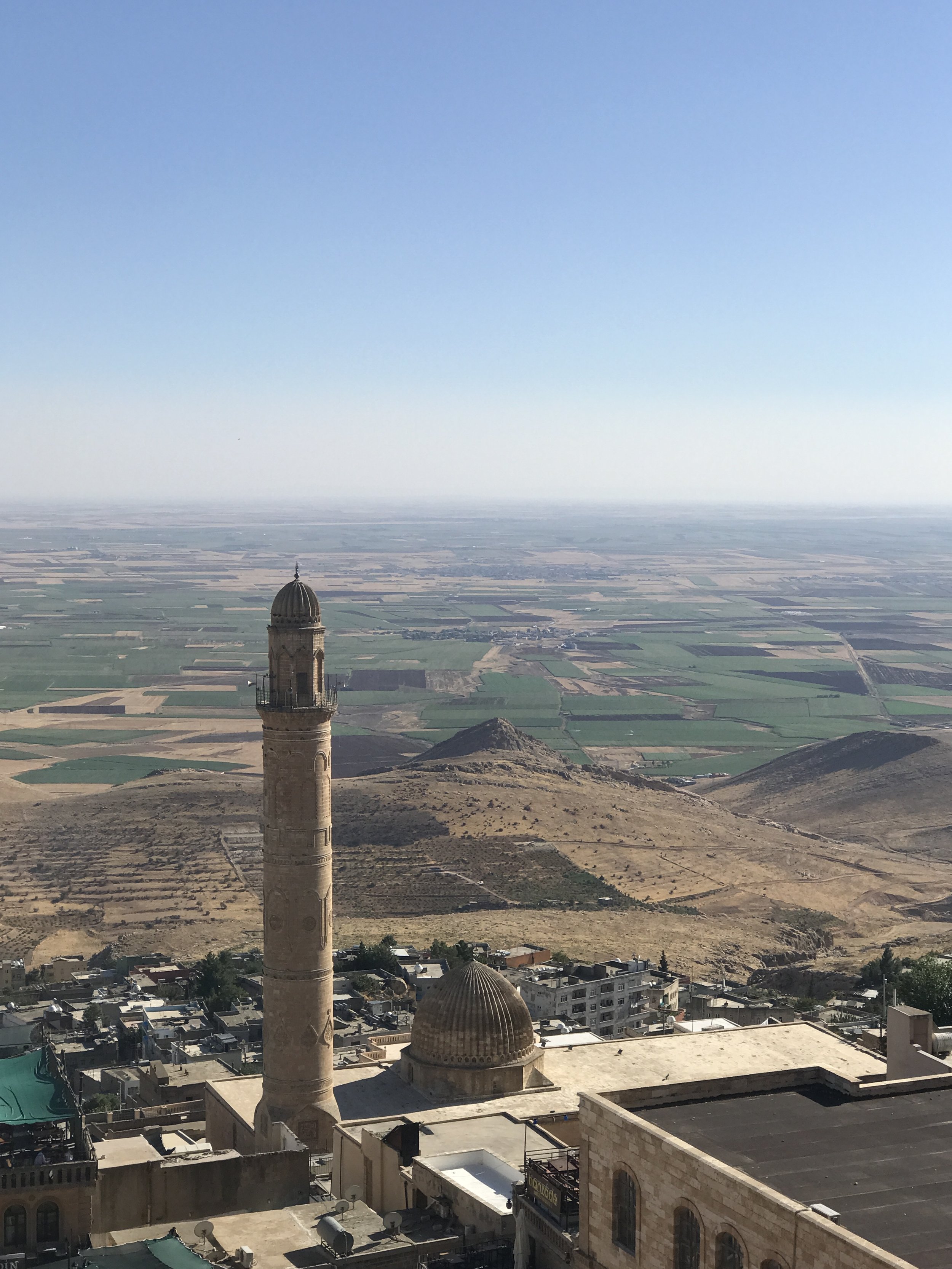
On a first visit, the one road that takes traffic sweeps through the whole crescent of ancient Mardin, overlooked by most of the principal restaurants and hotels. Above and below this busy road, ranges a warren of thirty irregular terraced levels, subdivided by alleys, staircases, covered passages and yards. Now drop into this mental map two dozen mosques, all signposted by elegant minarets, fluted domes and proud gatehouses, and a dozen fascinating churches mostly hidden behind high temenos walls and odd opening hours. Then throw in as many urbane palaces of merchant princes as you can imagine, then double this, and allow some to stand tall on their own terrace, whilst other older ones sprawl over multiple levels and embrace inner courtyards. They are all made of the same golden stone, and those from the 19th-century delight in shaded arcades, barrel-vaulted halls and grand staircases lined with the fat frames of baroque banisters. Everywhere, windows are embroidered with a fantastic energy of decorative stonecarving in happy contrast to the fortress like solidity of stone masonry walls.
Above the city sits the circuit walls of a commanding fortress (currently as it must have been for most of history – inaccessible) whose battered walls are compounded of so many dynasties, so many sieges and so many centuries that you have to (for the moment) tuck them all away in a sealed box and just label them ‘the past’. But if you have enough energy to tear yourself away from the brooding fascination of the city to walk in the hills around Mardin, you begin to release that this concentration of history is not unique. The limestone crest on which it sits is punctured by ancient caves and ruinous walls, some expanded by man, others briefly used as tombs, as the campsites of herdsmen, Paleolithic hunter-gatherers or as the headquarters of a medieval besieger. In this seemingly gentle landscape of neat orchards and rough highland grazing, I found traces of Parthian kingdoms, Byzantine frontier fortresses, Syriac monasteries, Roman ruins and Turkic Medrese.
It is this history that makes the view south from Mardin so consistently compelling. But there were other surprises. On my first night I noticed flickers of red light that grew into waves, then subsided, then reappeared elsewhere, for the wind that evening was propitious for the efficient firing of stubble fields. After the harvest is gathered in the summer, if there is access to water, there is a second season of maize, lentils or cotton.
The longer I stayed, the more complex this view became. You are not looking at just the north-south frontier between Anatolia and Arabia - between the modern-day Turkish Republic and that of Syria - but also at an east-west crossing zone, where the Levantine coastal culture bleeds into Asia. It is a place that has been home to all the proudest ethnic elements of the Middle East: Turks, Kurds, Armenians, Assyrians and Arabs, subdivided by all their kaleidoscopic divisions of dialect, dynasty, clan, confederation and faith. You are sitting on one of the fissure lines of mythology and history. In the archaeological museum there is a bearded sky god usefully labelled as Zeus, but also as Teshup of the Hittites, Enlil of the Sumerians, Marduk of Babylon, Assur of Assyria or Haldi of Urartia. Immediately south of Mardin, standing on the last precipice of Anatolia the flat green sea of fecund fields which is Mesopotamia begins. The northern third of Mesopotamia has long been known to the Arabs as Al-Jazira. It is a view that summons up the eternal rivalry between the shepherd and the farmer, between the brothers Cain and Abel, Qabil and Habil of the Koran.
My first morning exploring Mardin was delightfully unplanned, for I was in the hands of two famous British writers on Turkey, Jason Goodwin and Jeremy Seal, and they had plotted a zigzag of a road journey searching out the few things in this region that they had not yet explored. Jeremy parked at random on the eastern edge of town and we pottered off, allowing our eyes to be drawn to anything with a dome or a minaret. Quite by chance our first visit was to Hamza-i-Kebir Zaviyesi, a small medieval mosque with glazed tiles above the doorway that is crowned by an elegant fluted white dome. Four of the internal arches had been enhanced by black and white masonry (local basalt and limestone) to make a pleasing contrast. It had been built in 1438 by one of the princes of Akkoyunlular (the White Sheep Turks) just a few decades after this dynasty had seized control of Mardin from their Black Sheep rivals. Its near neighbour looked even more enticing. Malik Mahmut Camii (built for As-Salih Shams Ad-Din Mahmut, son of Ghazi, who ruled from 1312-1364) has a much more imposing prayer hall, furnished with simpler, bolder muqarnas, a higher dome, a finer minaret and the first of the raised, very imposing, richly carved gateways that we would encounter all over Mardin, etched with eroded calligraphy that has been transcribed to identify donors and restorers.
It was here that I encountered the specific elements of Mardin religious architecture. It would get bigger, bolder and ever-more dramatic as I slowly explored the rest of the city, but the principals are the same, for the slope and the orientation of the city dictates the structure. A comparatively narrow, rectangular sunken entrance courtyard is always approached from an ornate gatehouse set in the side - so you step up, then down through a dark arched-passage to emerge into a blaze of light. This internal courtyard space has its own dramatic dance depending on the time of day, which creates a subtly shifting play of strong shadows, cool arcades and almost visionary blocks of powerful sunlight. When your eyes are ready you notice that in the north wall (built up high to support the rising ground), there is invariably a simple archway niche recessed into the earth, catching the trickle from a pure spring of water. The magic of clean, clear drinking water gushing from the earth is rightly celebrated all over the world, but here it has the additional holy function of providing water for the ritual ablutions by which a worshipper cleanses themselves ready for prayer. The architects of Mardin have everywhere enhanced this by running the water along rills, over small stone cascades where it creates chuckle and enchants with refractions of light and conspire to set the spring in direct alignment with the mihrab (the ornamental niche in the centre of the prayer hall).
This flow of water has its own mystical interpretation: springing from the earth (our birth), then the noise, sparkle and energy of youth (the cascade) dropping down into the quiet ordered flow (the rills) which expresses the discipline of work, marriage and parenthood before the obliteration of energy as the water drops into the basin, reminding us of the dissolution of death, but also stillness and clarity as we are pierced by the rays of sunlight (the Day of Judgement). Due to the nature of the falling ground in Mardin, the prayer hall is wide rather than deep - forming a comparatively narrow rectangle in harmony with the courtyard. The cumulative effect is dazzling, and an easy and entirely satisfying combination of the four elements: Earth from the carved stones, Air from the cool serenity of the prayer hall, Fire from the sharp sunlight held in the courtyard and water from the spring.
This was just an introduction to the even greater architectural marvels I would progressively encounter, such as the 13th-century Latifiye, Ulu Camii (dating from the 12th century but much restored in the 19th), and the deservedly famous Sultan Isa Zinciriye medresse (1385) and the even more gorgeous out-of-town, Kasimiye Pasha Medresse (began in 1407 but completed a generation later in 1445). And the wonderfully elaborate pair of 12th-century Mihrab niches, dancing with elaborate numerical symbolism, (including 40 stars for the forty years of his life before the Prophet Muhammad received the first revelation, and 63 rosettes for the sixty-three years of his life) which has survived from the 12-th century Sitti Radviye (Hatuniye) mosque complex restored as a medresse. (Built in 1176-84 by Sultan Kudbettin Ilgazi in honour of his mother)
From coins in museum collections (often struck with bold, figurative, dynamic forms) and precious fragments of court-commissioned manuscripts (such as the first edition of Dede Korkut) but above all from this gorgeous heritage of buildings at Mardin one salutes the lavish energy of the medieval dynasties. The Artuqid structures (1108-1409) may have had a political dimension, directed by the need to assert an orthodox Sunni identity on Mardin, which under the previous dynasty (Hamdanid) was the walled capital of a Shiite Emirate whose armies fought against both Christian Crusaders, Kharajite Bedouin and the Sunni Abbasids.
In their heyday, both the Artuqid (1108-1409) and Ak Koyounlu (1432-1508) Sultans ruled from the great city of Diyarbakir to the north. Mardin by contrast was often ruled by cadet branches of these two powerful clans, and was more a place of learning ,equipped with a hilltop fortress of last resort. The first Artuqid Sultan, who had risen to power as a loyal general within the Seljuk Turkic army was made governor of Diyarbakir. The Ak Koyounlu (the romantically named White Sheep Turks) had a similar pattern of origin, serving as Turkic warlords in the armies of the Mongol Khans and then of Tamburlane, once again ascending the throne though the governorship of Diyarbakir.
The early 16th-century brought a titanic clash of powers to this region, as the Ottoman Sultanate, the Mameluke Sultanate of Egypt and Syria and Safavid Iran battled for dominance and survival. In three years of blistering warfare, 1514-17, the disciplined army of the Ottomans, personally led by Sultan Selim the Grim, and highly skilled in the use of mobile field artillery, destroyed all its rivals. A Venetian merchant travelling through Mardin in 1507 observed that there were still as many Jews and Christians in the city as Muslims. Travellers passing though the city before the horrible destruction, displacements, famines and massacres of the First World War, remarked on such grand new buildings as the Post Office, the (1895) Syriac Patriarchate and the (1889) Ottoman cavalry barracks, now an art gallery. They noticed that aside from Ottoman officials, the indigenous Muslim population was essentially half Arab and half Kurd, and the Christian population of about 20,000, equally divided between the Syriac and the Armenian Churches. Armenian jewellers specialised in gold, the Syriacs in silver. Most of the Muslim merchants were linked to one of fourteen rival clans, all the ‘sons of Haci Kermo’ – a bizarre sliver of social history that fanned out from the descendants of a warrior-hero who had fought in the army of Sultan Murad IV in his victorious campaign against the Persians in 1635.
Mardin has a very ancient Muslim presence, established just eight years after the death of the Prophet Muhammad. The city surrendered to an Arab army commanded by Iyad ibn Ghanm ibn Zuhayr, warrior from the Prophet’s Quraysh tribe and an early convert to Islam. Between 639 and 641 he established Arab siege camps that blockaded the local cities during the harvest allowing him to round up the herds and take hold of the crops. With a minimum of spilt blood, one by one the chief cities of the region made their submission and signed the formal terms of surrender, detailing the Muslim toleration for other faiths and the agreed terms of tribute and poll tax. First Raqqa, then Edessa, Mardin and Dara signd formal treaties with the Muslim Caliphate. Only the walls of Nisibis had to be stormed in bloody conflict.
We could hear echoes of this story in Mardin, but by descending down from the hills and entering the Al-Jazira plain, we were able to touch it. I had shed Jason and Jeremy, and a year later returned to Mardin with the Istanbul-based photographer, Monica Fritz. She had an introduction to Hussein, a charming, energetic young art-historian from a local museum who we co-opted as our guide, who in his turn cajoled a succession of friends to drive us, turning my arid quests into archaeology into picnic outings.
So under the direction of Hussein we arrived at the Roman fortress of Dara in the early morning light, the broken walls scattered amongst live farm buildings filled with chickens and cows, the ploughed fields alternating with orchards. Although I love history, there is nothing so delightful as stumbling on the past without too much advance preparation. So the high section of Roman wall at the southern face of the ancient city of Dara was a magnificent surprise. An old mill had been fitted within one of the surviving Roman towers while I was fascinated to discover that the defences at their lowest level were pierced by arches that framed deep tunnels, clearly once guarded by multiple iron portcullises. The river bed was dry, but elsewhere we found bridges and embankments that suggested a different past, or seasonal periods of spate. Just when I felt sated with discovery, Hussein opened a door, and with a flourish and a low bow, welcomed me to the Roman Empire. Alone, without a torch, I descended into a vast, cavernous, underground cistern, exceeding in size and the grandeur what you might expect of a Romanesque cathedral. Indeed I was later told that a Byzantine church had once stood above these vaults and that there is a second, almost equally capacious cistern at Dara, which is open to the sky and therefore not such a staggeringly good surprise. Dara had been a small military garrison of the ancient Persian Empire, with coins found from the reign of Darius III (336-330 BC) but all the buildings that I had marvelled at that morning were not so much Roman as Byzantine, rushed up between 503-507 by the Emperor Anastasius, as a forward base camp from which a mobile field army could safely operate. In those years, the Sassanid (Persian) frontier post was just 5kn south. The remnants of the southern gatehouse that I had admired was once part of a 4km enclosure of walls, later raised to 20 metres in height. The vast cisterns were not only designed to supply an army, but by diverting streams were also designed to deny the enemy any access to water.
After breakfast - piles of delicious spinach and cheese flatcake pancakes were devoured - we were taken to a mournful quarry, from which the city walls had been excavated. In later life it had been fretted with rock-cut tombs, dating from the 6th-14th centuries. The biggest of these tombs was a state funded complex of three storeys created in 591 to house the bodies of the Byzantine soldiers massacred when the city fell to the Sassanids in 573. Dara was clearly not an invulnerable fortress. Although a Byzantine garrison reoccupied it in 591, it fell to siege once again in 604, and was repossessed by the Emperor Heraclius in 628. So its surrender to the Arab Muslim army in 639 was in the context of a ding-dong frontier war. The Mongols flattened what was left of the city in the 14th century, after which even the quarry cemetery fell silent.
Guidebooks and experienced travellers all warned to stay away from Nusaybin, what with the Syrian frontier snaking its path all round the city, and memories of the fighting in 2016. The city was full of shops selling electronic gadgets, or whatever was in short supply on the other side of the frontier, and we found a rooftop café that overlooked the border crossing, which usefully kept spare pairs of binoculars, so you could do your own spying at the nature of the mixed Rojava-Syrian-Russian regime on the other side of the frontier.
But we had come to Nusaybin on a specific Roman art-history mission, and found it easy to identify the new UNESCO cultural quarter by the tall minaret that marks out a pleasant green park just to the east of which is a sunken area of archaeological excavation. This mosque is a fascinating place of pilgrimage in its own right, one of the places hallowed to the memory of Zayn al Abidine, the great grandson of the Prophet Muhammad, the child who escaped the massacre of Kerbala. Beside it, in the sunken excavations, you can just about make out the shape of half of an ancient basilica-shaped cathedral, but it is a confused area for ancient Nisibis was one of the most fought over battlegrounds of the ancient world, sacked, burnt and rebuilt more times that one wishes to chronicle.
Just to the east of the excavations is a rectangular structure, looking a bit like an abandoned railway station. Inside we discovered two ancient chambers, the first one much repaired by later buttresses and vaults, but the southern domed chamber was astonishingly beautiful. Bold, confident, four-square and load bearing, the late Roman vaults supported a shallow dome. There was a raised altar area, a free-standing altar and a subterranean crypt complete with the original sarcophagus of Mor Yakup (Saint Jacob), chosen to be bishop of Nisibis at a Syriac Church council held at Diyarbakir. It is assumed that these two interconnected chambers once served as the baptistery for the neighbouring cathedral, but they may also have been free-standing chapels. We can probably start dating their use from the life of Mar Yacoub as bishop, 313-320, but an inscription helps pin the structure of the vaults and dome to 360 AD. So it was built in that fascinating period when Christianity co-existed with the classical pagan world, and aesthetically this felt true. What held the eyes was the gorgeous under-cut tracery carved into the stone vaults; beautiful, accomplished, fluid, lively tendrils of vines, clusters of grapes as well as unfolding leaves of acanthus leaves to give a touch of Corinthian order to the solid pilasters. It felt like a stone version of Coptic embroidery, a line of ornate colour picked through otherwise plain linen, playing with the restraint and solidity of the stone walls in one gorgeous stripe of life. Here, perhaps was the touchstone that for centuries afterwards inspired the artisans and sculptors of Mardin.
The period in which Mor Yakup was built and decorated was obsessively interesting. For over the 4thcentury, Nisibis was held by Rome and attacked in three great set-piece sieges by the army of the Sassanian Empire, in 337, 346 and 350. At one point Persian engineers dammed the rivers that drained the Tur Adbin highland, only to release this lake in a floodtide which they hoped would undermine the city walls, while squadrons of armoured elephants, provided with grappling arms, attempted to topple the destabilized walls. We know so much of the detail of these battles, for amongst the young Roman officers in the ranks of the Parthica I legion was Ammianus Marcellinus, one of the great military historians. It was also a period of subtle cultural shift, as pagan intellectuals became wary of the rising tide of Christian mob violence in the old cities of the Roman Empire and looked to the East, to Sassanid Persia, as a possible place of refuge. In 350 we know that a university, the School of Nisibis taught philosophy, theology and medicine here. Other groups of exiles attempted to maintain the intellectual freedom of the old classical world at Antioch and at Gondishapur in Iran. The Emperor Julian, also caught up in dreams of reviving this endangered classical world, attempted to repeat the conquests of Trajan, and launched an invasion of Iraq. He died somewhere near Samarra, but his Roman army (which had fallen under the command of Jovian, the least ambitious and most jovial member of the Imperial Guard) managed to limp back to the safety of their frontier. But to guarantee this, he was forced to surrender Nisibis and its five adjacent districts to the Sassanian Shah. This was, on one level, just another tit-for-tat adjustment in the endless frontier war between Rome and Persia, but for the Syriac Church it had very important ramifications. At a stroke, the Syriac Church now passed under the benign protection of the Persian Sassanian Empire, at just the period when the Roman Empire became exclusively Christian and doctrinaire and began to persecute those with whom it disagreed.
It was time to turn the day towards a picnic, which we did by travelling north into the Tur Abdin hills through the beautiful Cacak valley, and ate trout grilled with peppery herbs and salad dressed with lemon and pomegranate syrup, beside the banks of this enchanting stream.
The next day we were ready for Deir-al-Zafaran, the Saffron monastery. Not nearly as old as Mor Yakup, it has a mystique and a fragrance of its own. Fortress-like, it is perched on a hill just four miles outside Mardin, overlooked by caves and grottoes that could shelter a hundred hermits in silence and hide refugees fleeing from the persecution of the Greek Orthodox Church. It is a place of continuous Christian worship for at least 1,500 years, where the liturgy is chanted in Aramaic, the language of Christ. On one level it is now a tourist monument, for the Syriac community and faith has dwindled but it has a vibrant life as a pilgrimage destination. The worldwide diaspora of Syriac Christianity, whether resident in Istanbul, Europe or North America, is healthy and wealthy and often homesick and my visit coincided with just such a visit, so the monks were happy and hospitable, the church thronged and the candles smoking.
As a direct consequence of the state persecution of all the Eastern Churches by the Greek Orthodox administration of the Byzantine Empire, the highland region of Tur Abdin, on the frontiers of the Persian Sassanian Empire, became not just a safe place of refuge, but ultimately a spiritual homeland. According to some traditions, Deir-al-Zafaran began life in 493, when an old temple sanctuary where the Sun God and Hercules were once worshipped, was now occupied by a community of Syriac monks that included lone anchorites in tomb-like shelters in the hills. The ancient Martyrion chapel, its side vaults filled with imposing stone sarcophagi, feels architecturally the oldest structure, but the current organisation of the monastery dates from a formal refoundation by Mor Hananyo (St Ananias), the Syriac bishop of Mardin, in 793. So the domed, pyramid-like roof of the Church of Mary, to one side of the monastery cloister, might date from this period. Since 1293 the monastery has hosted the Syriac Patriarchate of Antioch, which after the foundation of the Turkish secular Republic migrated to Syria in 1924.
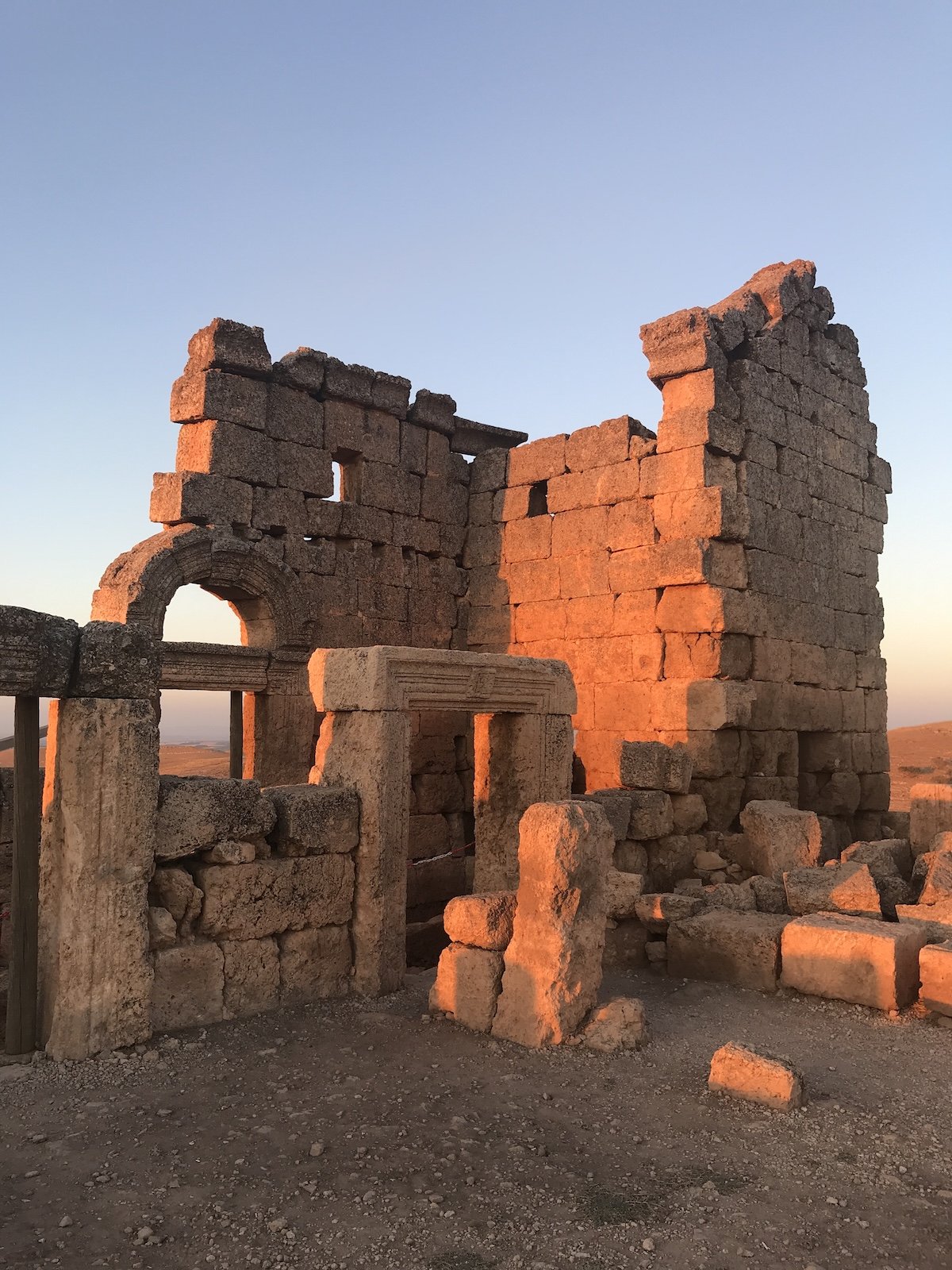
The following day, we once again prevailed on Hussein to take us off on a picnic outing, to climb the hills north of Mardin and explore Ksar Zerzevan (sometimes called Samachi) which guards the quickest route north across the highlands to Diyarbakir. The castle is being excavated, but instead of prohibiting us entry the site guardians took us on a magical tour of the place, concluding with tea at a table as the sun set. The southern watch-tower, still three storeys high, allows you to imagine the fortress in its heyday, its fifteen-metre-high curtain walls draped over this mountain summit, complete with storehouses and water cisterns dug into the bedrock. The site dates back to an Assyrian watch-tower and was then a station on the Royal Road of Persia, but the current structure dates from the reign of the Emperor Severus (198-235 AD) almost certainly part of his logistical preparation for his successful invasion of northern Mesopotomia. Like other walls I had clambered over in this region, it was repaired by Anastasius and Justinian and fell to the Arabs in 639.
Our final pilgrimage was back in the Tur Abdin mountains, to visit Mor Gabriel (Qartmin) monastery, which was founded by a Syriac hermit in 396 AD but is named after Saint Gabriel, the revered Syriac bishop of Dara who helped navigate the church through the politics and invasions of the 7th century. My heart sunk at the sight of the new boundary wall, fresh white marble balustrades and gleaming new tarmac drive. I was glad when I succeeded in losing my assigned tour group, especially when I found myself alone in the vast, rather crude, barrel vaulted nave of the old church. The real treasure of the place was the tiny sanctuary chapel recessed in the side wall, with its battered cosmati pavement of red, black and white marble mosaic. The altar had been restored to cemetery-grade polished marble but above it the barrel vault gleamed with the faded silver, gold and green glass of an original Byzantine mosaic. It was curiously like what you might admire in the Great Mosque of Damascus: no figurative image of Christ or the Virgin, just windblown trees, vine tendrils and a lamp before a holy sanctuary, with the early Christian symbol of the so-called Iconoclastic Cross, with two drops of blood on each end of the cross beam.
There were no shadows, no perspective but a clear spiritual vision. I found myself bending down to kiss the threshold, when I stood up I found an old pilgrim beside me, who related the story of the hermit Saint Samuel, how he had come to the graveside of a young boy who had been beheaded and ending up leading the mourners in their prayers, before reverently placing the head back in its place in the grave. That night a miracle took place, and the boy rose from the grave to warn the village of an invasion of Persian cavalrymen before becoming the saints first follower. The pilgrim then looked at me, and asked my pardon for talking unbidden, “some talk with their lips, but is better to speak from the heart.” He confessed that as a young man it had been easy for a Christian to get the right papers to migrate to Europe: at the Austrian consulate they even smiled. I asked after his life in Europe: which he dismissed with a shrug, but that it paid well enough, and he and his wife loved coming back to visit the monasteries and catch up with remnants of his family.
We had tea in the Geluske Han, a handsome, yellow-stone courtyard off the bustling streets of Midhat, with its cafés, wine shops, craft galleries, boutique hotels and old ladies contentedly selling their needlework in the streets. Midhat is a happy place with its gorgeous central plaza and although the bell towers of the churches are now silent, this is also the fate of many a lovely old church in Britain. We wanted to pick up some advice on finding one of the last Yezidi communities in these hills. After many a wrong turn on country lanes, we found a Yezidi meeting place and a cemetery used by three different family-clans, with many musicians recorded on the distinctive, high gravestones. Our guide was a refugee from Iraq, who worked on the community garden. He had a proud, brave but gaunt face, and decided to ask no more questions after I heard that he had been forced to flee from the murderous Isis led violence that had engulfed his Sinjar homeland in 2014. Instead we sat, drank deliciously chilled well water and chattered about his vegetable patch. He confessed that it was not really a village anymore, just a scattering of mansions used by Yezidi families who liked to return for the summer holidays and family celebrations. He gave me a melon when we parted. The taste was of summer sweetness cut by a sharp bitterness, like the experiences of this refugee now sheltering in the Tur Abdin. published in CORNUCOPIA, issue No 68, 2025